
IPVanish review: iPhone users who want automatic connection rules
A candidate for iPhone/iPad users who want connection automation and selective website exclusions, based on its published app capabilities.
Where it makes sense
- You use iPhone or iPad and want connection behavior tied to your network rules.
- You want to investigate domain exclusions without turning off the VPN for everything.
Limitations to weigh
- You require a desktop feature that has not been verified in the relevant provider documentation.
- You are choosing on a claimed benchmark or streaming result that this review has not tested.
Evidence and review scope
We checked IPVanish's provider-authored Apple and Google Play descriptions on 5 November 2026. Its main website blocked our research request. The Android listing corroborates continued availability and broader platform support, while the discussion below focuses on the Apple workflow. We did not infer closure from a blocked request or perform connection tests.
The clearest verified use case
IPVanish is worth examining for iPhone and iPad users who want more control over when their VPN connects. Its provider-authored Apple listing describes on-demand rules and selective website bypass. Those capabilities offer a more specific reason to consider it than a general claim that a VPN is fast or secure.
This review deliberately keeps that scope visible. We could read the published Apple and Android descriptions, but the main IPVanish website blocked our automated research request. We therefore do not turn unverified desktop features, price promotions or old compatibility claims into current facts.
Automation should match your routine
Think about where you want the VPN to be active: public Wi-Fi, a familiar home network or the phone's mobile connection. On-demand controls are useful only when they reflect that routine. Before depending on them, inspect the settings and confirm what happens when the phone moves between networks.
A practical evaluation would include locking and unlocking the device, reopening an app and checking the connection after a network change. We have not performed those checks with IPVanish. They are a way for a buyer to test whether the documented controls produce the expected behavior on their own phone.
Selective bypass needs a clear purpose
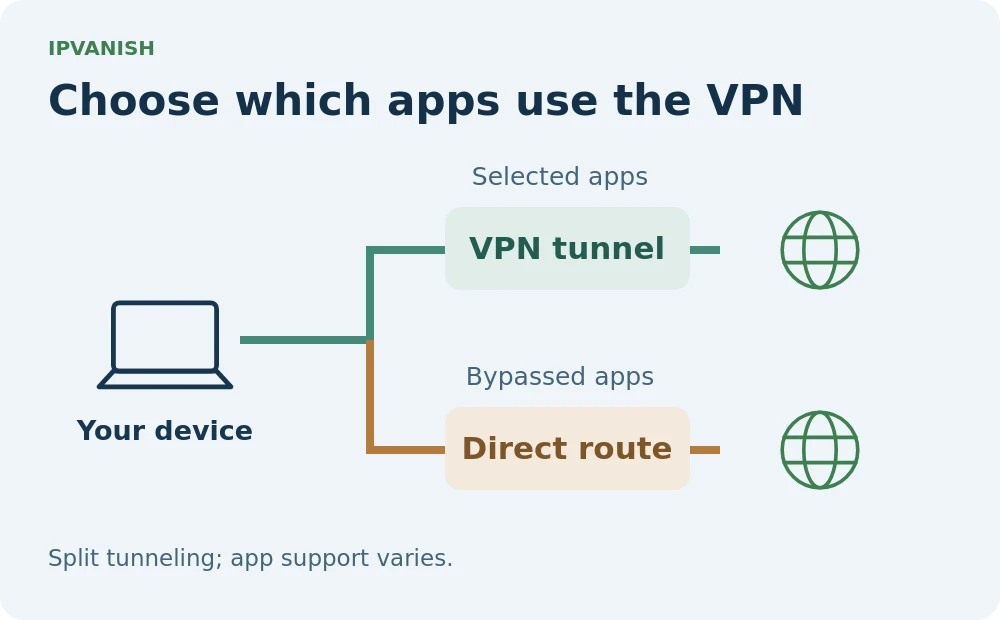
The Apple description documents domain-based split tunneling. Consider it when one website has trouble with a VPN connection and you still want other browsing to use the tunnel. Be precise about what you exclude; an exception should solve a known problem rather than become an unexplained collection of websites.
The corresponding trade-off is that excluded traffic does not receive the same VPN routing. Keep a short record of why each exception exists. If you later change devices, revisit the decisions instead of assuming the new app has identical settings or behavior.
Evaluate protective features individually
IPVanish lists a kill switch and Threat Protection in its Apple description. These features address different tasks: connection handling and blocking certain unwanted destinations. Their presence is useful information, but it does not establish a detection rate, a leak-test result or complete protection from malicious content.
Ask what problem you are trying to solve before adding another security feature to your routine. Review settings, permissions and recovery steps. If enabling a control interrupts something important, establish why before disabling every safeguard together. Keep ordinary account protections and device updates in place.
Buying with the right evidence
The service is subscription based, and a trial can lead to an automatic renewal. Read the price and cancellation terms shown by the actual purchase channel rather than assuming a website promotion applies to an app-store purchase. Save the confirmation so that the term is easy to check later.
Our verdict is a qualified shortlist recommendation for the documented Apple workflow. Anyone buying primarily for Windows, Linux, a router or a particular streaming service should seek current provider instructions and perform a relevant check first. An inaccessible research request is a verification limitation, not a reason to label an active product dead.
Pricing and value
Check the current checkout for the total initial payment, renewal charge, term length and purchase-channel refund conditions. Promotional headline rates are not used in this review.
Who should buy it
iPhone users who want automatic connection rules
Who should skip it
You require a desktop feature that has not been verified in the relevant provider documentation. You are choosing on a claimed benchmark or streaming result that this review has not tested.
Before you subscribe
Is IPVanish a free VPN?
The provider describes it as a paid subscription service with a trial. Review renewal terms before starting a trial.
What does the Apple app support?
Its published description lists WireGuard and IKEv2, on-demand rules, domain-based split tunneling and an internet kill switch.
Does a blocked vendor website mean the service is closed?
No. Our research request received HTTP 403, while its provider-authored App Store listing remained available. That is not evidence of closure.
Keep exploring



About this research
Jimmy TragerOriginal contributor
Credited on original VPN Software content. Updated versions carry a separate revision credit.
VPN SoftwareResearch-based assessments
AI-assisted research from linked sources. No hands-on testing is implied.
Reference desk 2
- apps.apple.com/us/app/ipvanish-vpn-fast-secure/id763638165 for Current provider documentation for features, compatibility or plan limitations checked November 5, 2026
- play.google.com/store/apps/details for Provider-authored Android listing, broader platforms and protocol family checked November 5, 2026